Executive Historical Dispatch & Survival Metrics
Expedition: The Imperial Trans-Antarctic Expedition (1914–1916) | Primary Vessel: Endeavour (later christened Endurance, 144-foot three-masted wooden barquentine) | Personnel: 28 men + 1 stowaway + 69 sled dogs | Ship Beset: January 18, 1915 | Ship Crushed & Sunk: November 21, 1915 | Open-Boat Voyage: 800 nautical miles across the Scotia Sea in the 22.5-foot James Caird | Casualties: Zero (all 28 men survived).
When Sir Ernest Shackleton placed his legendary, perhaps apocryphal, recruitment notice in London newspapers in 1914, it reportedly read: “Men wanted for hazardous journey. Low wages, bitter cold, long hours of complete darkness. Safe return doubtful. Honour and recognition in event of success.” Thousands of men responded. Having lost the race to the South Pole to Roald Amundsen in 1911, Shackleton conceived the last grand prize of Antarctic exploration: the Imperial Trans-Antarctic Expedition, an audacious 1,800-mile overland crossing of the entire Antarctic continent from the Weddell Sea to the Ross Sea via the South Pole.
The expedition never set foot on the continental mainland. Instead, it produced what is universally acknowledged as the greatest survival epic in maritime and polar history. For nearly two years, cut off from human contact as World War I raged across Europe, Shackleton and his twenty-seven men survived the crushing of their wooden ship by pack ice, months of drifting on freezing ice floes, open-boat voyages across the hurricane-whipped Southern Ocean, and an alpine crossing over uncharted glaciated peaks—without losing a single life.
The Ship and the Trap: The Weddell Sea Ice Pack (1914–1915)
Shackleton’s vessel was the Endurance, a 300-ton barquentine crafted in Norway from solid Scandinavian oak and greenheart wood, designed specifically to withstand polar pack ice. Departing South Georgia Island on December 5, 1914, the ship entered the notoriously unpredictable, swirling pack ice of the Weddell Sea.
For weeks, Captain Frank Worsley threaded the ship through leads of open water amid towering ice floes. But in mid-January 1915, just one day’s sail (under one hundred miles) from their intended landing site at Vahsel Bay, a fierce northeasterly gale packed the ice tightly against the continental shelf. On January 18, 1915, at 76°34′ S, the Endurance was frozen fast into the pack ice. As Shackleton recorded with chilling clarity, the ship was “frozen like an almond in the middle of a chocolate bar.”
Ten Months of Confinement and the Death of the Endurance
Recognizing that liberation was impossible until the following spring, Shackleton converted the icebound ship into a permanent winter station, nicknamed “The Ritz.” Sled dogs were housed in prefabricated dog igloos (“dogloos”) on the ice, while the crew maintained strict daily routines of scientific observations, soccer matches on the floe, lantern-slide lectures, and phonograph concerts.
However, the Weddell Sea ice pack was not static. Driven by oceanic currents, the colossal ice sheet was rotating in a clockwise gyre, carrying the trapped ship hundreds of miles northward toward the Southern Ocean. By September 1915, the spring thaw exerted titanic lateral pressure on the hull. Massive pressure ridges of ice, thirty feet high, ground against the wooden timbers with deafening shrieks that shook the ship’s frames.
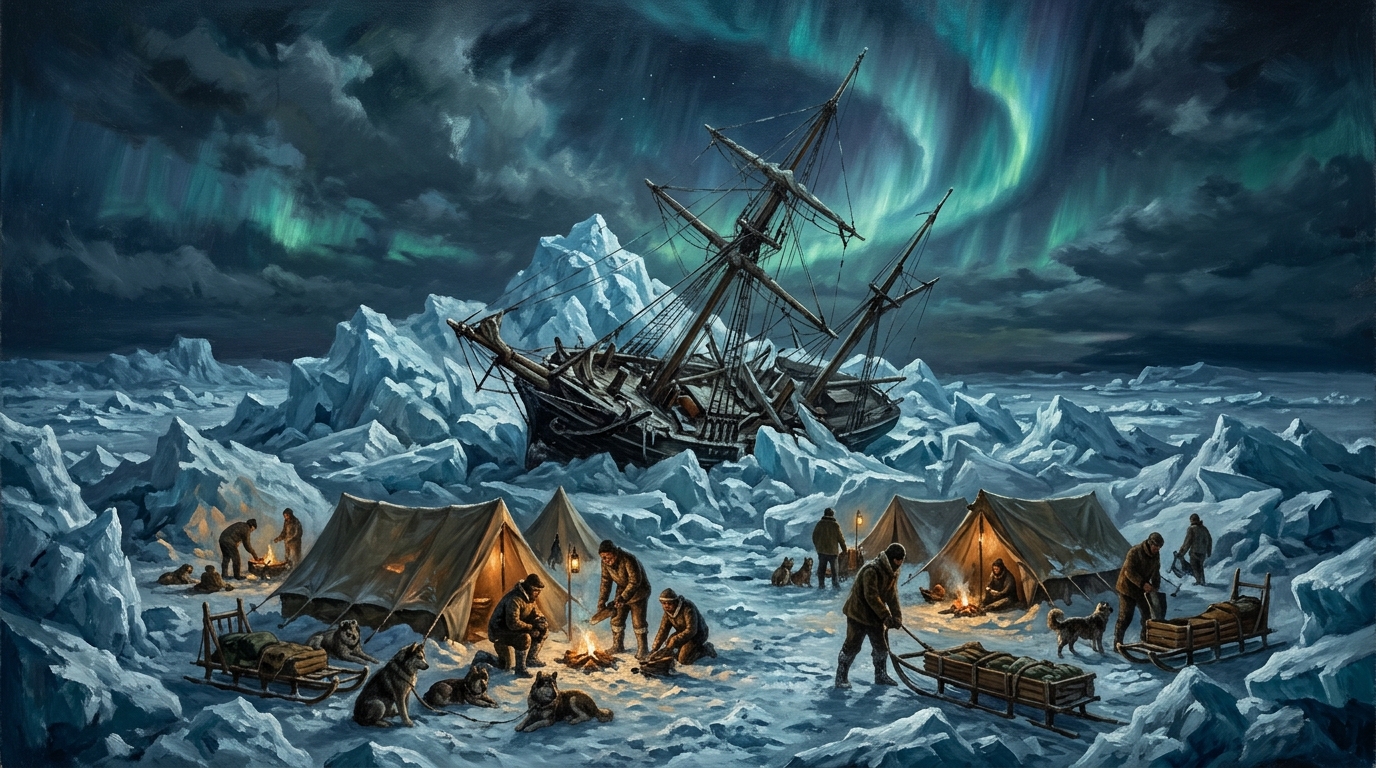
On October 27, 1915, after the rudder was ripped away and seawater burst through the crushed sternpost, Shackleton gave the order to abandon ship. For several weeks, the men camped on the floating sea ice watching their home slowly die. Finally, on November 21, 1915, the crushed hull slipped beneath the freezing surface of the Weddell Sea. Shackleton turned to his men and quietly uttered: “Ship and stores have gone; so now we’ll go home.”
Drifting on the Ice Floes and the Dash to Elephant Island
For five agonizing months, the twenty-eight men lived in canvas tents atop floating ice floes, enduring sub-zero blizzards, wet reindeer sleeping bags, and dwindling rations of seal and penguin blubber. Shackleton maintained iron morale through his infectious optimism and egalitarian discipline, ensuring that officers and sailors received identical rations and performed identical manual labor.
By April 1916, the ice floe had drifted north into the open ocean and was disintegrating beneath their feet into pitching ice fragments. On April 9, Shackleton ordered the men into their three salvaged twenty-two-foot wooden lifeboats: the James Caird, the Dudley Docker, and the Stancomb Wills.
For seven tortuous days, battered by freezing spray, massive breaking waves, and killer whales surfacing alongside the fragile gunwales, the men rowed through the chaotic ice pack. Thirst-crazed and frostbitten, on April 15, 1916, they pulled their boats onto the narrow, gravel beach of Elephant Island—a desolate, wind-scoured rock formation outside all shipping lanes. It was the first time the men had stood on solid ground in 497 days.
The Epic Voyage of the James Caird (April–May 1916)
Shackleton knew that rescue would never come to Elephant Island; the men would starve or freeze as winter closed in. He resolved to attempt the near-impossible: an 800-nautical-mile open-boat journey across the Drake Passage and Scotia Sea—the stormiest stretch of water on Earth—to reach the remote whaling stations of South Georgia Island.
The ship’s Scottish carpenter, Harry McNish, prepared the best lifeboat, the James Caird (22.5 feet long), raising her gunwales with salvaged wood planks, decking her over with canvas, and sealing the seams with oil paint and seal blood. Shackleton selected five companions for the suicide mission: Captain Frank Worsley (master navigator), Tom Crean, Harry McNish, John Vincent, and Timothy McCarthy.
Sixteen Days in Hell
Departing Elephant Island on April 24, 1916, the six men endured sixteen days of living hell. Monstrous waves—the dreaded “Cape Horn Rollers,” sixty to eighty feet high—towered over the tiny wooden craft. Heavy freezing sea spray turned to solid ice on the canvas decking, making the boat dangerously top-heavy and forcing the men to crawl across the frozen canvas with pocketknives to chip away the ice while clinging on for their lives.
Navigation was a miracle of human skill. Under perpetually overcast skies and raging storms, Frank Worsley managed to take only four sightings with his pocket sextant across the entire 800-mile voyage, holding onto the mast while two men gripped his legs to prevent him from being pitched into the sea. A navigational error of even a fraction of a degree would have caused the boat to miss South Georgia entirely, sending them to certain death in the limitless Atlantic.
On May 8, 1916, through a break in the storm clouds, Worsley sighted the jagged, glaciated peaks of South Georgia Island. In a final display of seamanship, navigating through a hurricane that sank an 800-ton cargo steamer in the same waters, Worsley brought the battered James Caird safely ashore in King Haakon Bay.
Crossing South Georgia’s Uncharted Mountains
The ordeal was not over. King Haakon Bay was on the uninhabited southern coast of South Georgia; the Stromness whaling station lay on the opposite side of the island. Between them rose a jagged, uncharted mountain range of alpine glaciers, razor-edge crevasses, and 9,000-foot peaks that no human had ever crossed.
Leaving three exhausted men beneath the overturned James Caird, Shackleton, Worsley, and Tom Crean set out on foot on May 19, 1916. Equipped only with fifty feet of rope and McNish’s carpenter screws driven through the soles of their boots for traction, the three men marched continuously for thirty-six sleepless hours across the mountain spine.
At one point, trapped on a frozen mountain ridge at dusk as freezing mist gathered, Shackleton realized they would freeze to death if they lingered. Gathering the climbing rope beneath them like a toboggan, the three men locked arms and launched themselves into the pitch-black abyss, sliding 2,000 feet down an icy precipice in minutes, miraculously landing in a snowbank at the bottom.
On the afternoon of May 20, 1916, three ragged, unwashed apparitions—their faces blackened with seal blubber smoke, hair matted down to their shoulders, and clothes in shredded tatters—walked into the manager’s villa at the Stromness whaling station. When the station manager, Thoralf Sørlle, stared in stunned disbelief, the lead figure spoke quietly: “My name is Shackleton.”
The Rescue of the Elephant Island Men
Having immediately dispatched a whaling ship to collect the three men on the southern shore, Shackleton dedicated the next four months to rescuing the twenty-two men marooned on Elephant Island under the command of his iron-willed deputy, Frank Wild. Living inside two overturned boats insulated with snow, Wild’s men had survived on limpets, seal meat, and unshakeable faith in “the Boss.”
Three successive rescue attempts in small wooden vessels were repelled by impenetrable winter pack ice. Finally, on August 30, 1916, on his fourth attempt aboard the Chilean naval steam tug Yelcho, Shackleton broke through the ice fog and sighted Elephant Island. As the boat pulled close, Shackleton counted the figures standing on the beach through his binoculars. Turning to Worsley, his voice choked with tears: “They are all there, Frank! Every single one!”
Chronological Timeline of the Imperial Trans-Antarctic Expedition
| Date | Location | Critical Survival Milestone |
|---|---|---|
| December 5, 1914 | South Georgia Island | HMS Endurance departs into the icy waters of the Weddell Sea. |
| January 18, 1915 | Weddell Sea (76°34′ S) | Endurance is completely beset by pack ice, beginning a 10-month drift. |
| October 27, 1915 | Weddell Sea Ice Floe | Crushing pressure breaches hull; Shackleton orders ship abandoned. |
| November 21, 1915 | Weddell Sea | The crushed Endurance sinks beneath the ice; men camp on sea ice floes. |
| April 9 – 15, 1916 | Open Ocean to Elephant Is. | Seven-day desperate open-boat navigation to reach desolate Elephant Island. |
| April 24 – May 10, 1916 | Scotia Sea | Historic 800-mile open-boat voyage of the James Caird to South Georgia. |
| May 19 – 20, 1916 | South Georgia Mountains | 36-hour non-stop alpine mountain crossing to reach Stromness whaling station. |
| August 30, 1916 | Elephant Island | Shackleton returns aboard Chilean tug Yelcho; all 22 marooned men rescued. |
| March 5, 2022 | Weddell Sea (9,869 ft depth) | Wreck of Endurance located in pristine preservation by Falklands Maritime Heritage Trust. |
Shackleton’s Enduring Leadership Lessons
Shackleton’s survival saga has become the premier case study in transformational crisis leadership. Management scholars point to his emotional intelligence, operational flexibility, and unwavering prioritization of his crew’s psychological morale over personal glory.
When the original geographical goal became unattainable, Shackleton did not waste energy lamenting the failed continental crossing; he instantly pivoted 100% of his intellect and resources toward a single new objective: bringing every man home alive. As polar geologist Sir Raymond Priestley famously penned: “For scientific leadership, give me Scott; for swift and efficient travel, Amundsen; but when you are in a hopeless situation, when there seems no way out, get down on your knees and pray for Shackleton.”
Key Archival Takeaways
- Crisis Agility: Instantly abandoned continental crossing objectives to focus exclusively on human survival when the ship was beset.
- Superhuman Seamanship: The 800-mile navigation of the 22.5-foot James Caird by Frank Worsley in hurricane seas remains the greatest open-boat voyage ever accomplished.
- Zero Fatalities: Through relentless optimism, psychological equity, and unhesitating personal sacrifice, Shackleton preserved the lives of all twenty-eight men.
Frequently Asked Questions (FAQ)
Was the wreck of the Endurance ever found?
Yes. On March 5, 2022, 107 years after she sank, the wreck of the Endurance was discovered by the Endurance22 expedition at a depth of 9,869 feet (3,008 meters) in the Weddell Sea. Preserved by the freezing, oxygen-poor water and absence of wood-eating organisms, the ship was found in breathtaking condition, with her wooden hull upright and the gilded lettering “ENDURANCE” gleaming on her stern.
What happened to the dogs on the expedition?
Tragically, all sixty-nine sled dogs had to be shot as meat supplies failed on the drifting ice floes during the winter of 1915–1916. The meat was consumed by the crew to prevent starvation and scurvy, and the final litter of puppies and ship’s cat “Mrs. Chippy” were euthanized before the boats departed for Elephant Island.
What became of the James Caird lifeboat?
The James Caird was shipped back to England and now rests on permanent display in the North Cloister of Dulwich College in London, where Ernest Shackleton attended school as a boy.