ARCTIC EXPLORATION ARCHIVES · 1893–1896
A Ship Built to Drift Through the Frozen Arctic Ocean
Discover why Norwegian explorer Fridtjof Nansen deliberately allowed the Fram to become trapped in sea ice—and how his remarkable expedition changed polar exploration.
In the late nineteenth century, the central Arctic Ocean remained one of the least understood regions on Earth. Explorers had repeatedly attempted to reach the North Pole, but thick sea ice, extreme cold, and unpredictable conditions made progress extraordinarily difficult.
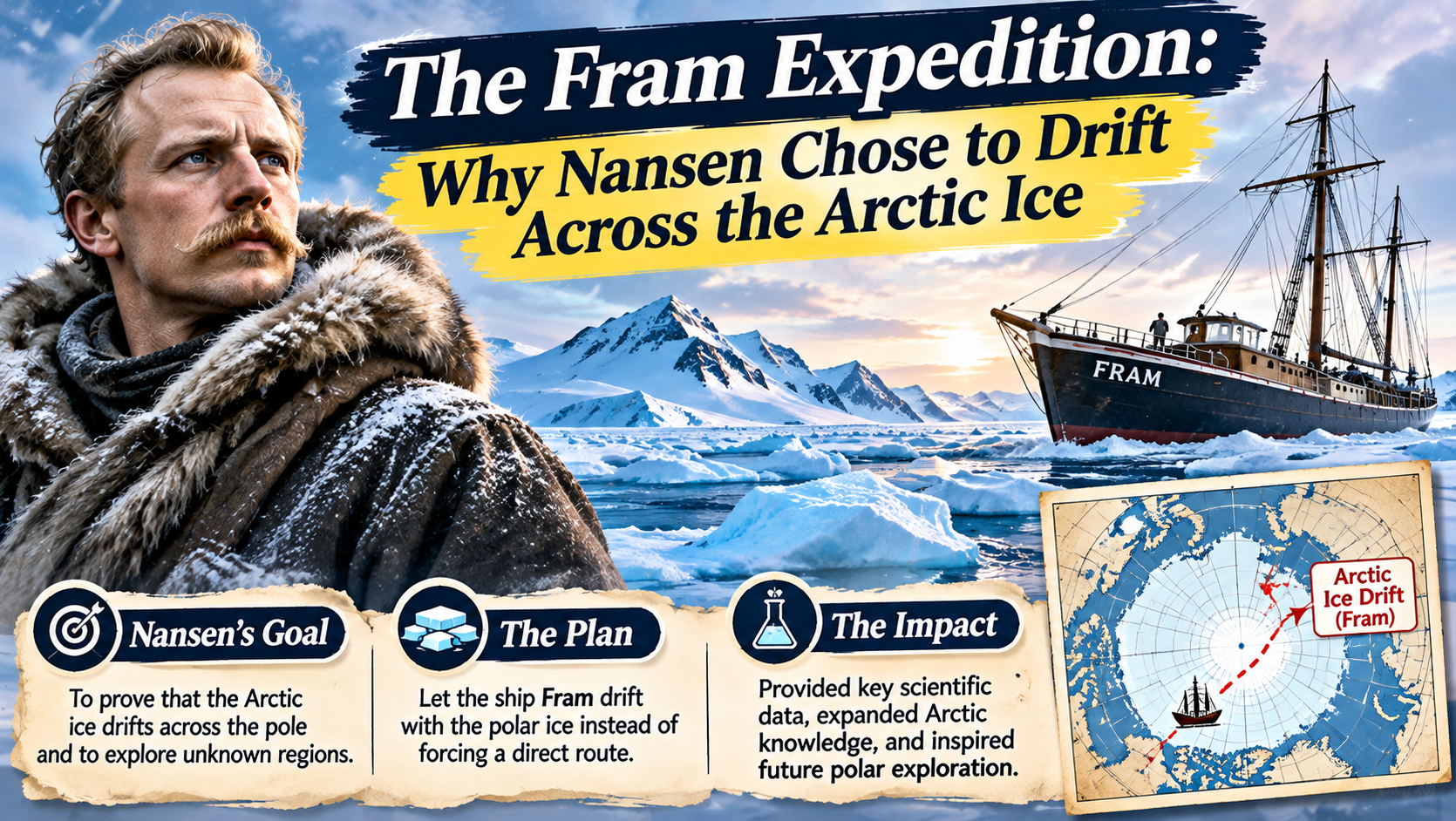
Most expeditions viewed being trapped in ice as a disaster. Norwegian explorer Fridtjof Nansen proposed something radically different: he would deliberately allow a specially designed ship to become frozen into the Arctic pack ice and let the natural movement of that ice carry the expedition across the ocean.
The vessel was named Fram, meaning “Forward” in Norwegian. Its voyage between 1893 and 1896 became one of the most important expeditions in the history of polar exploration.
Although Nansen did not reach the North Pole, the expedition demonstrated the existence of large-scale ice drift across the Arctic Ocean and produced valuable scientific observations.
The story of the Fram is not simply an account of survival in extreme conditions. It is a fascinating example of how scientific reasoning can transform an apparent obstacle into an exploration strategy.
The Arctic Exploration Challenge in the 1800s
During the nineteenth century, many expeditions attempted to travel northward through Arctic waters. Ships frequently encountered extensive pack ice that could stop progress for months or damage their hulls.
Traditional vessels were vulnerable to pressure from moving ice. When floes compressed against a ship, enormous forces could crush its wooden structure.
Explorers generally tried to avoid becoming trapped, searching for open-water passages or favorable seasonal conditions.
However, Nansen began considering whether the ice itself could provide a route across the Arctic Ocean.
His idea emerged from observations suggesting that objects carried by Arctic ice could travel enormous distances over several years.
The Discovery That Inspired Nansen’s Plan
One of the most important clues came from the ill-fated American expedition aboard the Jeannette.
The Jeannette became trapped in Arctic ice and was eventually crushed and sank in 1881, north of Siberia.
Several years later, objects associated with the ship were discovered near Greenland.
This suggested that material originating in the Siberian Arctic could travel across the polar ocean with drifting sea ice.
Nansen interpreted the evidence as support for a large-scale movement of ice from the Siberian side of the Arctic toward the Greenland region.
He reasoned that if a properly designed ship could survive being frozen into the pack, it might travel with the same drift.
THE CENTRAL IDEA
Instead of fighting the Arctic ice, Nansen planned to travel with it.
The expedition would depend on natural ice movement rather than attempting to force a ship directly through the frozen ocean.
Why Nansen Believed Drifting Could Work
Nansen’s reasoning combined physical evidence with a bold geographical hypothesis.
If sea ice moved from the Siberian Arctic toward Greenland, then a ship embedded in that ice might cross parts of the central Arctic Ocean.
He hoped the drift would carry the expedition close enough to the North Pole to make further exploration possible.
However, the exact route, speed, and duration of the drift were uncertain.
There was also no guarantee that the ice would carry the ship near the Pole.
The plan was controversial because deliberate entrapment exposed the expedition to risks that other explorers tried to avoid.
For Nansen, the key engineering challenge was designing a vessel that could withstand the pressure of the pack ice.
The Fram: A Ship Designed for Ice Pressure
The Fram was built specifically for Nansen’s expedition by Norwegian shipbuilder Colin Archer.
Unlike conventional ships, it had an unusually rounded hull designed to reduce the risk of being crushed by moving ice.
As ice pressed inward, the hull’s shape was intended to encourage the vessel to rise rather than remain trapped between opposing floes.
The ship also featured a strong wooden structure and substantial provisions for a long expedition.
Its design reflected the understanding that surviving prolonged ice pressure was more important than traveling quickly through open water.
ENGINEERING PROFILE · FRAM
Designer: Colin Archer
Expedition leader: Fridtjof Nansen
Launched: 1892
Key design feature: Rounded, strongly reinforced hull
Main purpose: Survive prolonged pressure from drifting sea ice
The Fram’s design became one of the expedition’s most celebrated achievements.
Its ability to survive the drift showed how specialized engineering could make previously impractical exploration strategies possible.
The Expedition Begins in 1893
The Fram departed Norway in June 1893 with Nansen and a crew of twelve other men.
After traveling along the northern coast of Siberia, the expedition deliberately entered the pack ice.
In September 1893, the Fram became frozen into the ice north of Siberia.
From that point onward, the vessel’s progress depended largely on the movement of the surrounding ice.
The ship was no longer navigating through open water in the conventional sense.
Instead, it became part of a moving ice field.
The crew prepared for an extended period of isolation while continuing scientific observations and maintaining the vessel.
Life Aboard a Ship Frozen Into the Arctic
Living aboard the Fram required discipline, patience, and careful organization.
The expedition had to cope with severe cold, long periods of darkness, and uncertainty about the ship’s movement.
Daily routines included scientific work, equipment maintenance, physical activity, and shared responsibilities.
The crew also had to monitor the ice surrounding the vessel.
Pressure from moving floes could create loud cracking sounds and dramatic changes in the ice surface.
Although the ship was designed to resist crushing, the crew could not assume that every ice-pressure event would be harmless.
Provisions, shelter, and routines were therefore central to the expedition’s endurance.
What Scientists Learned During the Drift
The expedition was designed not only to pursue geographical exploration but also to gather scientific information.
Researchers collected observations of ocean conditions, sea ice, weather, and other aspects of the Arctic environment.
One particularly important finding concerned the depth of the central Arctic Ocean.
Some earlier geographical theories had suggested that land might exist near the Pole.
Depth measurements made during the Fram expedition instead provided evidence of a deep ocean basin.
This contributed to a more accurate understanding of Arctic geography.
The expedition also strengthened the scientific case for large-scale movement of sea ice across the Arctic Ocean.
These observations helped establish foundations for later studies of Arctic oceanography and sea-ice dynamics.
Why Nansen Left the Fram in 1895
As the expedition progressed, Nansen realized that the ice drift was unlikely to carry the ship directly over the North Pole.
Rather than remain aboard and abandon his attempt to travel farther north, he developed a separate plan.
In March 1895, Nansen and Hjalmar Johansen left the Fram with dogs, sledges, and kayaks.
Their goal was to travel northward over the sea ice.
The journey was extraordinarily demanding.
Uneven ice, open leads, changing conditions, and the difficulty of transporting supplies slowed their progress.
Eventually, they recognized that reaching the North Pole was not feasible with their remaining resources.
They turned south toward Franz Josef Land.
The Northernmost Point Reached
In April 1895, Nansen and Johansen reached approximately 86°14′ north latitude.
At the time, this represented the farthest north that explorers had reliably reached.
Although they did not reach the Pole, their achievement was remarkable given the conditions and limited technology available.
The journey also demonstrated the difficulty of traveling over drifting pack ice.
Even when explorers moved northward relative to the ice, the ice itself could move in another direction.
This made progress unpredictable and complicated navigation.
Surviving the Journey Toward Franz Josef Land
After abandoning their attempt to reach the Pole, Nansen and Johansen traveled toward the Franz Josef Land archipelago.
Their journey involved crossing difficult ice terrain and navigating uncertain geographical conditions.
They eventually spent the winter of 1895–1896 in a primitive shelter on an island in the archipelago.
The men endured extreme isolation while relying on the resources and supplies available to them.
In 1896, they resumed their journey and encountered British explorer Frederick George Jackson.
Jackson’s expedition provided assistance, allowing Nansen and Johansen to return safely.
Their survival became one of the most widely remembered episodes of the Fram expedition.
What Happened to the Fram After Nansen Left?
After Nansen and Johansen departed, the Fram remained in the ice under the command of Otto Sverdrup.
The crew continued scientific observations while the vessel drifted through the Arctic pack.
In 1896, the Fram finally emerged from the ice and returned to Norway.
All thirteen original expedition members survived.
The successful return of both the ship and the men who had left it demonstrated the effectiveness of the expedition’s preparation and leadership.
Although the journey had not followed the exact route Nansen initially hoped for, it achieved major scientific and exploratory results.
Fram Expedition Timeline
| Year | Major Event |
|---|---|
| 1892 | The Fram is launched. |
| June 1893 | The expedition departs Norway. |
| September 1893 | The Fram becomes frozen into Arctic pack ice. |
| March 1895 | Nansen and Johansen leave the ship for a northward journey. |
| April 1895 | They reach approximately 86°14′ N. |
| 1895–1896 | Nansen and Johansen overwinter in Franz Josef Land. |
| 1896 | The Fram emerges from the ice; the expedition members return to Norway. |
How the Expedition Changed Arctic Science
The Fram expedition helped transform scientific understanding of the Arctic Ocean.
Its observations provided evidence that the central Arctic contained deep ocean water rather than an undiscovered continent.
The voyage also confirmed that sea ice could transport objects and vessels across large parts of the Arctic.
This movement is now understood as part of the broader circulation of Arctic sea ice.
The expedition encouraged later researchers to treat drifting ice as a potential scientific observation platform.
Modern polar research has expanded this idea using satellite positioning, automated instruments, research icebreakers, and advanced environmental sensors.
Although today’s technology is very different, the principle of observing the Arctic while moving with its ice remains scientifically valuable.
The Fram’s Lasting Legacy
The Fram later participated in additional Norwegian polar expeditions, including journeys associated with Otto Sverdrup and Roald Amundsen.
Its remarkable career made it one of the most famous vessels in polar exploration history.
Today, the ship is preserved at the Fram Museum in Oslo, Norway.
The vessel remains a powerful reminder of the period when polar explorers relied on wooden ships, astronomical navigation, sledges, and careful observation of the natural environment.
Nansen’s greatest contribution was not simply the distance he traveled.
It was his willingness to reconsider the problem of Arctic exploration.
Where earlier expeditions saw drifting ice primarily as an obstacle, he recognized that its movement might provide an opportunity.
Frequently Asked Questions
Why did Nansen deliberately freeze the Fram into Arctic ice?
He believed natural sea-ice drift could carry the specially designed ship across the Arctic Ocean, potentially bringing the expedition close to the North Pole.
When did the Fram expedition take place?
Nansen’s Fram expedition lasted from 1893 to 1896.
Did Nansen reach the North Pole?
No. Nansen and Johansen reached approximately 86°14′ N in April 1895 before turning south.
Who designed the Fram?
Norwegian shipbuilder Colin Archer designed the Fram with a rounded, reinforced hull intended to withstand pressure from sea ice.
What inspired Nansen’s drifting-ice theory?
Objects from the lost Jeannette expedition were discovered near Greenland, suggesting that Arctic ice could drift from the Siberian region toward Greenland.
What happened to the Fram after Nansen left?
Otto Sverdrup commanded the vessel as it continued drifting. The Fram eventually emerged from the ice and returned to Norway in 1896.
Why was the expedition scientifically important?
It provided valuable observations of Arctic ice movement, ocean depth, and environmental conditions, contributing to modern understanding of the Arctic Ocean.
Final Thoughts
The Fram expedition remains one of the most remarkable achievements in the history of polar exploration.
Fridtjof Nansen challenged the conventional belief that Arctic ice was only an obstacle to be overcome.
By studying evidence of drifting ice and designing a ship capable of surviving prolonged pressure, he developed an entirely different approach to exploration.
The expedition did not reach the North Pole, but it produced important scientific observations, demonstrated the feasibility of deliberate ice drift, and returned all its members safely.
Its legacy extends beyond the story of one ship or one explorer.
The Fram showed how scientific curiosity, engineering, and careful planning could open new possibilities in one of Earth’s most challenging environments.
ARCTIC HISTORY · KEY TAKEAWAY
Nansen Did Not Conquer the Ice. He Learned to Travel With It.
The Fram expedition demonstrated how understanding natural forces could transform the possibilities of polar exploration.