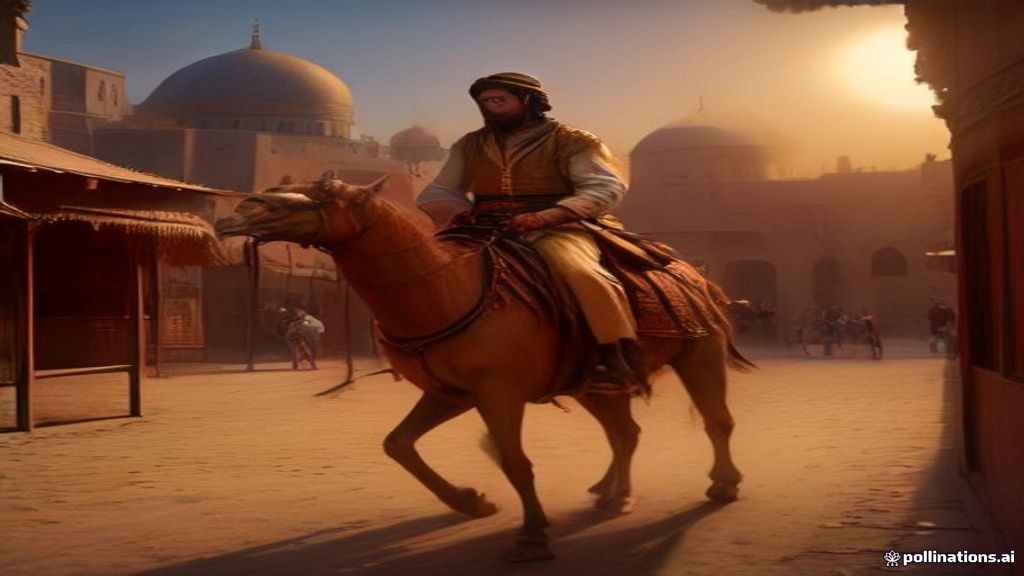
Executive Medieval Dispatch & Journey Parameters
Lifespan: February 24, 1304 – 1368/1369 CE | Active Traveling Years: 1325–1354 (29 consecutive years) | Total Estimated Distance: ~73,000 miles (117,000 km)—more than three times the distance covered by Marco Polo | Regions Visited: North Africa, Egypt, Arabia, the Levant, Anatolia, the Golden Horde, India, the Maldives, Southeast Asia, China, Moorish Spain, the Mali Empire (Sahara) | Primary Text: The Rihla (“A Gift to Those Who Contemplate the Wonders of Cities and the Marvels of Traveling”).
In June 1325, a twenty-one-year-old Islamic legal scholar (qadi) named Abu Abdallah Muhammad ibn Battuta rode out through the gates of his hometown of Tangier, Morocco. Mounted upon a single donkey and carrying only a traveler’s bag and prayer rug, his intention was pious and conventional: to perform the Hajj, the sacred Muslim pilgrimage to the holy city of Mecca, a journey anticipated to take approximately sixteen months.
Instead, Ibn Battuta did not return permanently to Morocco for nearly thirty years. Sustained by an unquenchable wanderlust, razor-sharp legal acumen, and the remarkable cosmopolitan security of the Dar al-Islam (“The Abode of Islam”), Ibn Battuta covered an estimated 73,000 miles across the breadth of Africa, the Middle East, Central Asia, India, Southeast Asia, and Imperial China. His journeys, preserved in his magnificent travelogue known as the Rihla, represent the most comprehensive firsthand eyewitness chronicle of the medieval world in existence.
The Dar al-Islam: The Medieval Interstate Highway
Ibn Battuta’s epic journey was made possible by a unique historical reality: the vast geographic expanse of the 14th-century Islamic world. From the Atlantic coast of Morocco to the river deltas of Bengal and the trading ports of Canton (Guangzhou), a single common language of scholarship (Arabic), a unified legal system (the Sharia), and an overarching ethical culture prevailed.
As a formally trained jurist of the Maliki school of jurisprudence, Ibn Battuta possessed portable, highly valued professional skills. Wherever he arrived—whether at the court of the Sultan of Delhi, the trading bazaars of Mogadishu, or the coral atolls of the Maldives—he was immediately embraced by local Muslim rulers who appointed him as a high-ranking judge (qadi), diplomatic envoy, or imperial administrator. He married aristocratic wives, commanded lavish stipends of gold dinars, fine robes, and enslaved attendants, and moved effortlessly through high medieval society.
The First Phase: North Africa, Mecca, and the Levant (1325–1326)
Trekking east along the North African coast, Ibn Battuta joined merchant caravans to protect against Bedouin bandits. Arriving in Alexandria, Egypt, he climbed the ancient Pharos of Alexandria (the celebrated Hellenistic lighthouse), noting that while partially ruined by earthquakes, one of its colossal square towers still stood.
In Cairo, the magnificent metropolis of the Mamluk Sultanate, Ibn Battuta was awed by the city’s crowded bazaars, massive hospitals (bimaristans), and madrasas. Traveling through Jerusalem and Damascus, he completed his first Hajj to Mecca in November 1326. But rather than returning home, standing beside the Kaaba, an insatiable desire to explore seized him. He resolved never to travel any road a second time if an alternate route existed.
Into the Steppes and Constantinople: The Golden Horde (1330–1332)
Sailing across the Black Sea, Ibn Battuta entered the vast grasslands of the Kipchak Steppe, the territory of the Golden Horde ruled by Sultan Ozbeg Khan. Traveling in a comfortable horse-drawn wagon known as a yurt, Ibn Battuta was deeply impressed by the high status accorded to Mongol women (khatuns), who rode openly without veils and participated directly in political councils.
In 1332, an extraordinary diplomatic opportunity arose: one of Ozbeg Khan’s royal wives, Princess Bayalun (the daughter of Byzantine Emperor Andronikos III Palaiologos), was preparing to travel to Constantinople to give birth. Ibn Battuta secured permission to join her armed imperial escort. Sighting the gilded domes of the imperial Christian capital, Ibn Battuta became one of the few medieval Muslims to leave a detailed description of Constantinople, visiting the Hagia Sophia (though declining to enter because he would not cross himself) and meeting with Emperor Andronikos III in the Blachernae Palace.
The Sultanate of Delhi and the Maldives (1333–1344)
Crossing the Hindu Kush mountains, in 1333 Ibn Battuta entered the wealthy, turbulent Delhi Sultanate of northern India, ruled by the brilliant, eccentric, and notoriously volatile Sultan Muhammad bin Tughluq. Tughluq was celebrated for showering foreign scholars with gifts of gold and jewels, but equally infamous for executing courtiers, ministers, and holy men on a whim.
Appointed Grand Qadi of Delhi by the Sultan, Ibn Battuta lived in luxury for eight years, collecting a lavish annual salary of 12,000 silver dinars. However, as Tughluq’s paranoia escalated into widespread purges, Ibn Battuta grew terrified. In 1341, seeking to escape the Sultan’s court, Ibn Battuta eagerly accepted an appointment to serve as the Sultan’s imperial ambassador to the court of the Mongol Emperor of China (the Yuan Dynasty).
Castaway in the Maldives
En route to the coast, Ibn Battuta’s diplomatic caravan was ambushed by Hindu rebels; stripped of his clothes, money, and diplomatic gifts, he escaped on foot through the jungle, surviving on wild berries. Regrouping in southern India, he sailed to the idyllic Maldives, where the local queen, Rehendi Kilege, desperately sought a trained Islamic jurist. Detained against his will, Ibn Battuta served as Chief Justice for nine months, enforcing strict Islamic dress codes and marrying into the royal family before resigning amidst political intrigues and sailing onward to Ceylon (Sri Lanka), where he climbed the sacred pilgrimage peak of Adam’s Peak.
The Voyage to China: The Edge of the Known World (1345–1346)
Navigating through the Strait of Malacca aboard a Chinese junk (which he described with admiration for its multi-layered watertight compartments, private staterooms, and massive rudders operated by hundreds of crewmen), Ibn Battuta reached the bustling southern Chinese port of Zaiton (modern Quanzhou) in 1345.
Ibn Battuta’s descriptions of Yuan Dynasty China reveal both profound admiration for its economic prosperity and cultural disorientation. He marveled at the universal use of lightweight paper money (chao), the peerless quality of porcelain ceramics manufactured in massive industrial kilns, and the extraordinary safety of the highway system, where merchants could travel unmolested across thousands of miles. Yet, as a devout Muslim, he felt deeply alienated by the non-Muslim society, writing: “China was beautiful, but it did not please me. On the contrary, I was greatly troubled thinking that paganism ruled over it.”
The Black Death and the Trans-Saharan Crossing (1348–1354)
Returning westward through the Middle East in 1348, Ibn Battuta witnessed the apocalyptic horrors of the Black Death (bubonic plague) ravaging Damascus, Cairo, and Aleppo, recording that over 24,000 citizens perished daily in Cairo alone. Arriving back in Tangier in 1349, he learned that his mother had died of the plague just months earlier.
Yet even this tragedy could not quench his wanderlust. In 1352, Ibn Battuta embarked on his final, most punishing overland expedition: crossing the burning furnace of the Sahara Desert with a salt caravan to explore the wealthy Mali Empire of West Africa.
Enduring blinding sandstorms where water skins ran dry and dead camels marked the trail, he reached Timbuktu, Gao, and the imperial capital of Mansa Sulayman (the successor to the legendary gold king Mansa Musa). While critical of the matrilineal customs and modesty standards of the court, Ibn Battuta left an invaluable historical testament praising the absolute security, racial harmony, and strict judicial fairness of the Mali Empire, noting that “neither traveler nor inhabitant has anything to fear from robbers or men of violence.”
Chronological Timeline of Ibn Battuta’s 73,000-Mile Travels
| Date / Period | Geographical Theater | Historical Milestone / Primary Experience |
|---|---|---|
| June 1325 | Tangier, Morocco | Departs on initial Hajj pilgrimage to Mecca at age twenty-one. |
| 1326 – 1330 | Middle East & East Africa | Performs Hajj; sails down East African coast to Mogadishu, Mombasa, and Kilwa. |
| 1331 – 1332 | Golden Horde & Byzantium | Visits court of Ozbeg Khan; travels to Constantinople with Princess Bayalun. |
| 1333 – 1341 | Delhi Sultanate, India | Serves as Grand Qadi under Sultan Muhammad bin Tughluq for eight years. |
| 1343 – 1344 | Maldives & Sri Lanka | Serves as Chief Judge in Maldives; climbs Adam’s Peak in Ceylon. |
| 1345 – 1346 | Yuan Dynasty China | Lands at Quanzhou (Zaiton); travels to Hangzhou and Beijing along Grand Canal. |
| 1348 – 1349 | Levant & Morocco | Witnesses Black Death across Syria and Egypt; returns home to Tangier. |
| 1352 – 1354 | Sahara & Mali Empire | Crosses Sahara with salt caravan; visits Timbuktu and court of Mansa Sulayman. |
| 1355 CE | Fez, Morocco | Dictates the complete manuscript of the Rihla to royal scribe Ibn Juzayy. |
The Rihla: The Literary Monument
Returning permanently to Fez in 1354, the Sultan of Morocco, Abu Inan Faris, commanded Ibn Battuta to preserve his extraordinary memories for posterity. For two years, Ibn Battuta dictated his travels to a gifted Andalusian poet and royal scribe named Ibn Juzayy, who polished the narrative into an elegant literary masterpiece titled Tuhfat al-Nuzzar fi Ghara’ib al-Amsar wa ‘Aja’ib al-Asfar (popularly known simply as the Rihla, or “The Travels”).
Ibn Battuta passed away quietly around 1368, serving as a respected judge in a Moroccan provincial town. For centuries, his manuscript was largely forgotten outside North Africa until French and British orientalists rediscovered copies in Algeria in the 19th century. Today, Ibn Battuta is universally recognized as the greatest traveler of the pre-modern world, whose writings provide an indispensable sociological, geographical, and human portrait of medieval Afro-Eurasian civilization.
Key Archival Takeaways
- Staggering Geographical Scope: Traversed 73,000 miles across forty modern nation-states, far eclipsing the journeys of any classical or medieval explorer.
- Institutional Fluidity: Thrived because the shared legal, theological, and linguistic infrastructure of the Dar al-Islam welcomed educated scholars across three continents.
- Invaluable Primary Source: The Rihla is the sole surviving contemporary written account of many medieval civilizations, including the Mali Empire and the Kilwa Sultanate.
Frequently Asked Questions (FAQ)
How does Ibn Battuta compare to Marco Polo?
While Marco Polo traveled roughly 24,000 miles over twenty-four years (primarily between Venice and Mongol China), Ibn Battuta covered over 73,000 miles over twenty-nine years, exploring far deeper into Africa, India, Southeast Asia, and the Middle East. Furthermore, as an educated legal scholar fluent in the lingua franca of his world, Ibn Battuta interacted directly with rulers, judges, and citizens as an insider, whereas Marco Polo was an illiterate merchant outsider dependent on court translators.
Did Ibn Battuta really visit China?
Some modern historians, such as Ross Dunn, have questioned whether Ibn Battuta reached as far north as Beijing, noting that his descriptions of northern China are less detailed than his accounts of India and Morocco. However, mainstream consensus agrees that he unquestionably visited southern China (Quanzhou and Hangzhou), as his observations of Chinese customs, banking, and nautical engineering are remarkably accurate.
What language did Ibn Battuta speak on his travels?
Ibn Battuta’s native language was Arabic, which served as the official international language of religion, law, trade, and diplomacy across the Islamic world. He also acquired functional knowledge of Persian (the language of high diplomacy in Central Asia and India) and basic Turkish during his time with the Golden Horde.