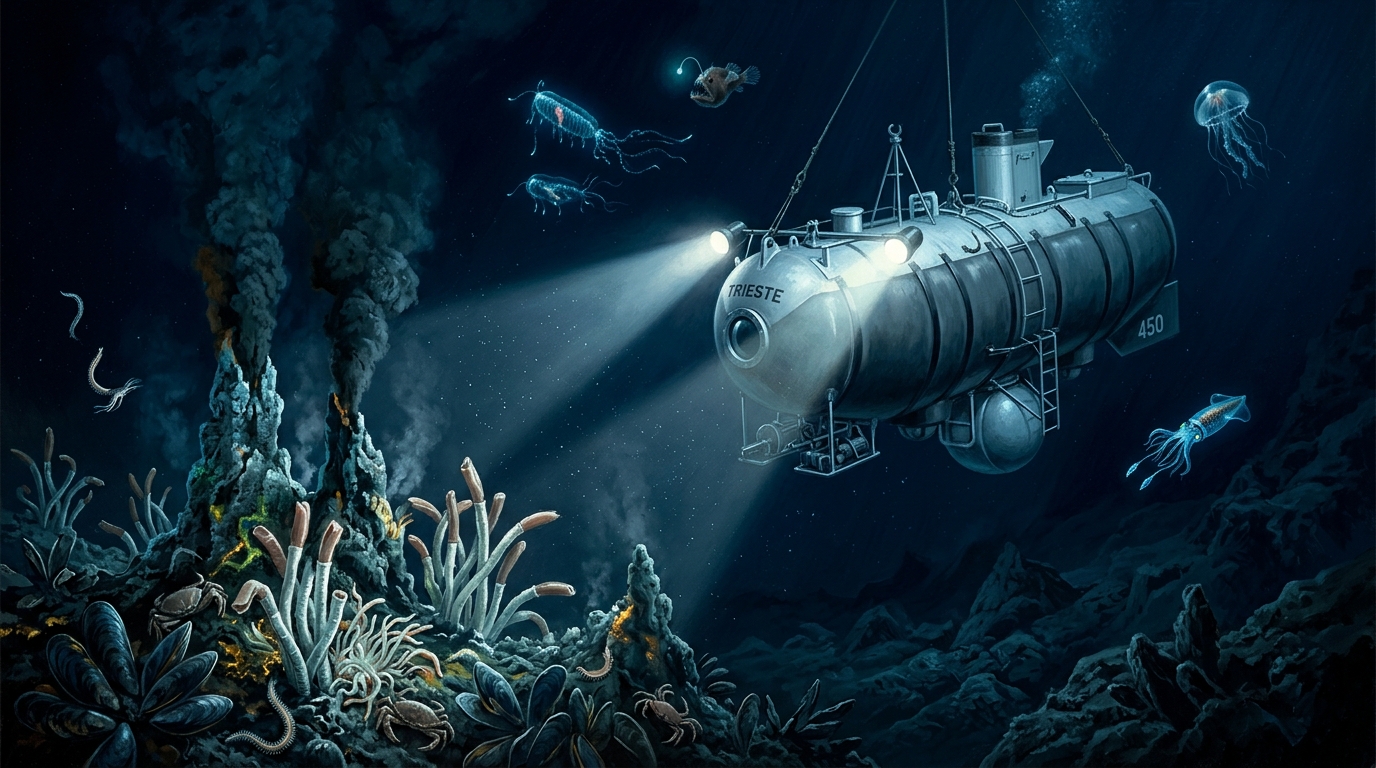
Executive Abyssal Dispatch & Hadal Zone Metrics
Deepest Point on Earth: Challenger Deep, Mariana Trench (~35,876 ft / 10,935 m) | Hydrostatic Pressure: ~1,086 bar (15,750 psi)—equivalent to 8 tons per square inch | Pioneering Descent: January 23, 1960 by Jacques Piccard & Don Walsh aboard the bathyscaphe Trieste | Subsequent Solo Descents: James Cameron (2012, Deepsea Challenger) & Victor Vescovo (2019, Limiting Factor).
For millennia, the ocean deeps represented an impenetrable barrier to human exploration. While astronomers mapped the craters of the moon and mountain climbers scaled the highest peaks of the Himalayas, the ocean floor below 20,000 feet—the hadal zone, named after Hades, the Greek underworld—remained more mysterious and inaccessible than outer space. Operating under total darkness, near-freezing temperatures (1–4°C), and hydrostatic pressures exceeding one thousand atmospheres, deep-sea exploration required engineering marvels that pushed human materials science to its absolute limits.
The quest to reach the deepest scar on Earth’s crust—the Challenger Deep within the Mariana Trench—represents one of the supreme triumphs of 20th-century physical exploration. It required abandoning conventional submarine design in favor of the bathyscaphe: a deep-diving underwater vessel operating on the buoyant principles of an airborne Zeppelin airship.
The Genesis of Abyssal Science: From Beebe’s Bathysphere to Auguste Piccard
Until the 1930s, oceanographers believed the abyssal plains were barren biological deserts, incapable of supporting complex life under crushing pressure. The breakthrough began in 1934 off Bermuda, when naturalist William Beebe and engineer Otis Barton descended to a record depth of 3,028 feet (923 meters) inside the Bathysphere—a 5,400-pound hollow cast-iron sphere suspended by a single steel cable from a surface ship.
While Beebe observed breathtaking bioluminescent jellyfish, hatchetfish, and siphonophores through fused quartz portholes, the tethered design was lethally dangerous. A severed cable meant instant death on the seafloor, while wave swells jerked the sphere violently through the water column. Free-swimming, untethered deep submersibles were desperately needed.
Auguste Piccard and the Physics of the Bathyscaphe
The solution came from an unexpected mind: Swiss physicist and balloonist Auguste Piccard. In 1931, Piccard had broken the world altitude record by ascending into the stratosphere (51,775 feet) inside a pressurized aluminum gondola suspended beneath a hydrogen gas balloon.
Piccard realized that the physical laws governing a balloon in the atmosphere could be inverted to conquer the abyss. In 1948, he invented the Bathyscaphe (from the Greek bathys meaning “deep” and skaphos meaning “vessel”):
- The Float (The “Balloon”): A massive, thin-walled steel hull filled with hundreds of thousands of liters of aviation gasoline. Because gasoline is lighter than seawater and virtually incompressible under high pressure, it provided positive buoyancy without requiring thick, heavy walls.
- The Cabin (The “Gondola”): A heavy, forged-steel sphere with walls several inches thick, suspended beneath the gasoline float, housing the two-man crew and instruments.
- Ballast System: To submerge, the vessel flooded air tanks with seawater. To ascend, the bathyscaphe utilized an ingenious fail-safe system: tons of iron pellet ballast held in hoppers by electromagnets. If electrical power failed, the magnets automatically de-energized, dropping the ballast and causing the buoyant gasoline hull to float safely back to the surface.
The Historic Descent of the Trieste: January 23, 1960
In 1953, Auguste Piccard and his son, oceanographer Jacques Piccard, constructed the bathyscaphe Trieste in Italy. Recognizing its strategic potential for underwater acoustic mapping and salvage, the United States Office of Naval Research purchased the Trieste in 1958 and launched Project Nekton—a series of classified deep dives culminating in the ultimate descent into the Mariana Trench.
On the morning of January 23, 1960, the Trieste bobbed in tumultuous swells 200 miles southwest of Guam. Inside the forged Krupp steel sphere (which possessed walls 5 inches thick and an inner diameter of just 6 feet 7 inches), Jacques Piccard and U.S. Navy Lieutenant Don Walsh squeezed together amid oxygen scrubbers, cameras, and electrical panels.
The Five-Hour Fall into the Challenger Deep
Flooding the ballast tanks, the Trieste began its silent, terrifying descent at three feet per second. At 1,000 feet, the last rays of sunlight vanished, plunging the craft into eternal hadal blackness. At 20,000 feet, the cold seeped through the steel hull, dropping cabin temperatures to 42°F (5.5°C) and causing condensation to run down the interior walls.
At 32,400 feet, a sharp, metallic gunshot-like crack shook the sphere. Walsh and Piccard checked their pressure gauges; the primary sphere remained intact, but an outer Plexiglas window in the entrance tube had cracked under the pressure of 14,000 pounds per square inch. Deciding not to abort, they continued downward.
At 1:06 PM, after four hours and forty-seven minutes of descent, the bathyscaphe’s echo sounder registered the seafloor. The mechanical depth gauge recorded 37,800 feet (later calibrated to 35,800 feet / 10,911 meters). Through the cone of quartz illumination, Piccard looked down upon a pristine, ivory-colored diatomaceous ooze.
To their astonishment, resting on the seabed was a flatfish—resembling a sole or flounder about a foot long—alongside a red hadal shrimp. This single observation demolished the long-standing scientific dogma that vertebrates could not survive in the hadal zone, proving that complex, oxygen-breathing ecosystems thrived under eight tons of pressure per square inch. After spending twenty minutes on the bottom, Walsh dropped sixteen tons of iron ballast, and the Trieste surfaced safely three hours later.
The Modern Era: Cameron, Vescovo, and Hadal Robotics
For fifty-two years, the 1960 dive of the Trieste stood as a lonely monument; no human returned to the Challenger Deep. The extreme cost, specialized metallurgy, and shift toward unmanned Remotely Operated Vehicles (ROVs)—such as Japan’s Kaikō in 1995 and Woods Hole’s Nereus in 2009—seemed to relegate manned deep-diving to history.
That paradigm shifted dramatically in the 21st century through private capital, advanced carbon synthetics, and passionate explorers:
James Cameron’s Deepsea Challenger (2012)
On March 26, 2012, filmmaker and ocean explorer James Cameron executed the world’s first solo dive to the Challenger Deep aboard the Deepsea Challenger. Designed as a vertical “torpedo,” the vessel was constructed from structural syntactic foam (containing microscopic hollow glass spheres) to withstand hadal pressure without gasoline floats. Cameron spent three hours collecting sediment cores and 3D high-definition footage, discovering bizarre amphipods and microbial mats.
Victor Vescovo and the Limiting Factor (2019)
In 2019, American explorer Victor Vescovo revolutionized abyssal access with the DSV Limiting Factor (Triton 36000/2). Featuring a 90mm-thick titanium pressure hull, the craft completed the “Five Deeps Expedition,” diving to the deepest points of all five world oceans. Vescovo dove to the Challenger Deep eight times, demonstrating that deep-sea submersibles could achieve repeatable, safe commercial operation.
Comparative Matrix of Manned Challenger Deep Descents
| Vessel | Year & Pilots | Hull Technology | Depth Reached |
|---|---|---|---|
| Bathyscaphe Trieste | 1960: J. Piccard & D. Walsh | Forged Krupp Steel (127mm) + Gasoline Float | 10,911 m (35,797 ft) |
| Deepsea Challenger | 2012: James Cameron | Steel Sphere (64mm) + Syntactic Glass Foam | 10,908 m (35,787 ft) |
| DSV Limiting Factor | 2019: Victor Vescovo | Titanium Grade 23 (90mm) Spherical Hull | 10,928 m (35,853 ft) |
| Fendouzhe (Striver) | 2020: Chinese Academy of Sciences | Ti-62A Advanced Titanium Alloy | 10,909 m (35,790 ft) |
Scientific Discoveries and Biological Adaptations in the Hadal Zone
The exploration of the Mariana Trench has unveiled an extraordinary biosphere defying classical biology. Organisms living in the hadal zone possess specialized biochemical adaptations to prevent cellular membranes from solidifying under hydrostatic pressure.
Scientists have isolated piezophiles (pressure-loving bacteria) and discovered that hadal fish, such as the Mariana snailfish (Pseudoliparis swirei, recorded at 26,000 feet), survive by concentrating high levels of trimethylamine N-oxide (TMAO) in their muscle tissues to prevent proteins from denaturing. Exploration has also revealed that hadal trenches serve as critical global carbon sinks, trapping organic detritus and regulating planetary biogeochemical cycles.
Key Archival Takeaways
- Physics of Buoyancy: The bathyscaphe triumphed by applying aerodynamic ballooning physics to hydrodynamics, utilizing incompressible aviation fuel for lift.
- Biological Revolution: Demolished the 19th-century “Azoic Hypothesis,” proving that complex vertebrate life and novel biochemistries flourish in extreme hadal depths.
- Material Mastery: Advanced from heavy forged-steel hulls to titanium Grade 23 and syntactic carbon foams, enabling repeatable multi-dive expeditions.
Frequently Asked Questions (FAQ)
How deep is the Mariana Trench compared to Mount Everest?
The Challenger Deep plunges to approximately 35,876 feet (10,935 meters). If Mount Everest (29,032 feet / 8,849 meters) were inverted and placed at the bottom of the trench, its summit would still be submerged under more than 6,800 feet (over 1.2 miles) of ocean water.
What happens if a submarine hull breaches at hadal depth?
At 1,000 atmospheres of hydrostatic pressure, a structural failure is instantaneous. The water jet piercing a micro-fracture enters at supersonic speeds, and the vessel collapses via catastrophic implosion in less than two milliseconds—far faster than the human nervous system can process sensory pain.
Did they find plastic in the Mariana Trench?
Tragically, yes. During Victor Vescovo’s 2019 dives aboard Limiting Factor, explorers documented synthetic plastic waste, including candy wrappers and plastic bags, resting on the sediment floor nearly 36,000 feet down, demonstrating the pervasive footprint of human pollution.