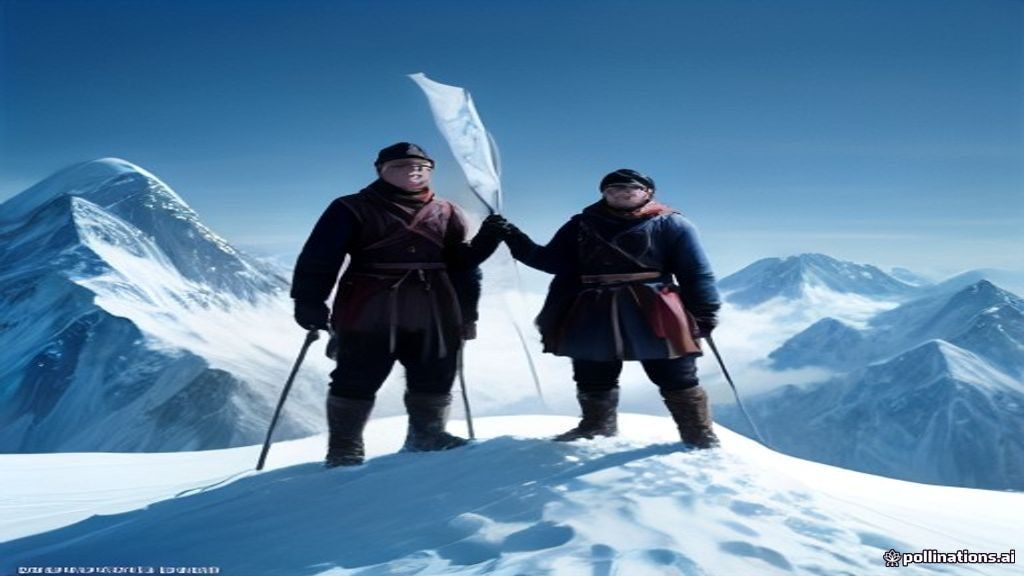
Executive Alpine Dispatch & High-Altitude Metrics
Summit Date: May 29, 1953 at 11:30 AM | Elevation: 29,032 ft (8,848.86 m) above sea level | Expedition Leader: Colonel John Hunt | Summit Pair: Edmund Hillary (New Zealand beekeeper) & Tenzing Norgay (Nepali-Indian Sherpa mountaineer) | Route: South Col via the Khumbu Icefall, Western Cwm, and Lhotse Face | Technological Innovations: Open-circuit oxygen apparatus, lightweight micro-cellular rubber boots, nylon rope bridges.
For more than three decades following the First World War, the summit of Mount Everest—known to the indigenous Sherpa and Tibetan people as Chomolungma (“Goddess Mother of the World”) and to the Nepalese as Sagarmatha (“Goddess of the Sky”)—loomed over human exploration as “The Third Pole.” After polar explorers had reached 90° North and 90° South, the highest geographical point on the planet remained unconquered, having claimed the lives of sixteen elite mountaineers, including the legendary 1924 disappearance of George Mallory and Andrew Irvine near the Second Step.
Rising nearly five and a half miles into the jet stream, Everest represented an extreme physiological frontier. Above 26,000 feet lies the “Death Zone”—an altitude where the human body cannot acclimatize, atmospheric pressure drops to one-third of sea level, and cellular degradation begins immediately. The 1953 British Mount Everest Expedition transformed high-altitude mountaineering from an amateur romantic pursuit into a precision military-scientific campaign, culminating in the historic summit ascent of New Zealand beekeeper Edmund Hillary and Sherpa sirdar Tenzing Norgay.
The Pre-War Attempts and the Mallory Mystery (1921–1924)
Early attempts on Everest were forced to approach exclusively from the north through Tibet, as the Kingdom of Nepal remained completely closed to foreigners. Expeditions organized by the British Mount Everest Committee in 1921, 1922, and 1924 marched across the arid Tibetan plateau in tweed jackets and nailed leather boots, using clumsy, seventy-pound oxygen sets that climbers bitterly referred to as “English air.”
On June 8, 1924, George Mallory—who, when famously asked by a New York reporter why he wished to climb Everest, retorted: “Because it’s there”—and his young companion Andrew Irvine were spotted through a telescope by geologist Noel Odell high on the Northeast Ridge, “going strongly for the top” at 28,200 feet, before storm clouds enveloped the mountain. They were never seen alive again. When Mallory’s frozen, sun-bleached body was discovered seventy-five years later in 1999 at 26,760 feet, the mystery of whether they had reached the summit before dying remained provocatively unresolved.
The 1953 British Expedition: Military Logistics on the Roof of the World
Following the 1950 Chinese takeover of Tibet, the northern route was closed. However, Nepal unexpectedly opened its southern borders to Westerners. In 1952, a formidable Swiss expedition pioneered a southern approach through the Khumbu Icefall, with legendary climber Raymond Lambert and Sherpa Tenzing Norgay reaching an astonishing altitude of 28,210 feet—barely 800 feet below the summit—before oxygen failure forced a retreat.
Determined not to let the Swiss claim the prize in 1953, the Joint Himalayan Committee of the Alpine Club and Royal Geographical Society appointed British Army Colonel John Hunt, an expert in military logistics, to direct the assault. Hunt treated Everest as an amphibious military siege:
- Manpower & Porterage: Over 350 Nepalese porters carried ten tons of food, fuel, and oxygen cylinders from Kathmandu to the basecamp at 17,900 feet, supported by thirty-five elite high-altitude Sherpas under Sirdar Tenzing Norgay.
- Dual Oxygen Systems: The expedition tested two distinct technologies: an experimental “closed-circuit” system (where exhaled breath was scrubbed of carbon dioxide and recycled) used by Tom Bourdillon and Charles Evans, and an “open-circuit” system (which mixed bottled pure oxygen with ambient air) utilized by Hillary and Tenzing.
- Cold-Weather Engineering: Windproof nylon-cotton tents, lightweight down sleeping bags, and insulated boots lined with expanded rubber prevented frostbite.
The Gauntlet of the Khumbu Icefall and Western Cwm
To reach the upper mountain, Hunt’s climbers had to conquer the Khumbu Icefall: a terrifying, two-thousand-foot frozen waterfall of moving glacial seracs and bottomless crevasses that moved up to four feet per day. Working with climbing ladders fashioned from aircraft aluminum, Hillary and the team bridged gaping abysses with ropes, establishing Camp II inside the silent, suffocating microwave heat of the Western Cwm.
From the Cwm, the climbers hacked 4,000 feet of steps up the sheer blue ice of the Lhotse Face, battling sub-zero winds to establish Camp VIII on the windswept, barren saddle of the South Col at 26,000 feet—the gateway to the Death Zone.
The First Assault and the Summit Push: May 26–29, 1953
Hunt planned a two-pronged assault. On May 26, the first summit pair, British climbers Tom Bourdillon and Charles Evans, ascended using closed-circuit oxygen. They reached the South Summit (28,700 feet)—higher than any human had ever stood—but found their oxygen valves clogged with ice. Realizing that pressing on would result in certain death, Evans and Bourdillon made the agonizing decision to turn back.
The second and final assault fell upon Edmund Hillary and Tenzing Norgay. On May 28, supported by George Lowe, Alfred Gregory, and Sherpa Pemba, Hillary and Tenzing hauled their loads to a precipitous ledge on the Southeast Ridge at 27,900 feet, pitching a tiny two-man tent on a sloping shelf of snow.
A Night in the Death Zone
That night, a furious gale battered the nylon fabric, threatening to pitch the tent down the 8,000-foot Kangshung Face into Tibet. Hillary and Tenzing spent the freezing night holding down the tent poles with their shoulders, melting snow for lemonade on a Primus stove, and conserving oxygen. At 4:00 AM on May 29, the wind died away. Hillary discovered that his leather climbing boots had frozen as hard as solid rock; he spent two hours roasting them over the stove flames to soften the leather before lacing them up.
Overcoming the Hillary Step to 29,032 Feet
At 6:30 AM, strapping on thirty-pound oxygen packs, the two men roped together and began cutting steps up the razor-edge Southeast Ridge. Flanking their right was the vertical precipice of the Kangshung Face; to their left, the sheer drop to the South Col. By 9:00 AM, they reached the South Summit.
Ahead lay the final formidable obstacle: a forty-foot vertical cliff of smooth rock and rotten ice that completely blocked the ridge, later named the Hillary Step. Squeezing his six-foot-two frame into a narrow crack between the rock face and a corniced fin of snow, Hillary jammed his crampon points into the ice and inched upward by pure muscle and friction. Panting heavily on his oxygen regulator, Hillary hauled himself onto the top of the step and belayed Tenzing up after him.
Beyond the step, the ridge curved gently upward over a succession of corniced snow domes. Cutting steps with his ice axe, Hillary crested a final knoll and stopped. There was nowhere higher to climb. It was 11:30 AM on May 29, 1953. Edmund Hillary and Tenzing Norgay stood on the highest point on Earth.
Hillary reached out to shake Tenzing’s hand, but the exuberant Sherpa threw his arms around the New Zealander in an emotional embrace. Taking off his oxygen mask, Hillary photographed Tenzing waving his ice axe adorned with the flags of the United Nations, Great Britain, Nepal, and India. Tenzing dug a small hole in the snow, offering biscuits, chocolate, and a red-and-blue pencil given to him by his daughter as a Buddhist and Hindu offering to the mountain deities. After fifteen minutes at 29,032 feet, aware of their dwindling oxygen, they began their descent.
Chronological Timeline of the 1953 Mount Everest Conquest
| Date | Location | Mountaineering Milestone / Strategic Action |
|---|---|---|
| March 10, 1953 | Kathmandu, Nepal | 350 porters and expedition staff depart for the month-long trek to Khumbu. |
| April 12, 1953 | Basecamp (17,900 ft) | Basecamp established on Khumbu Glacier; reconnaissance of the Icefall begins. |
| May 21, 1953 | South Col (26,000 ft) | Wilfrid Noyce and Annullu establish Camp VIII on the South Col without oxygen. |
| May 26, 1953 | South Summit (28,700 ft) | First assault by Evans and Bourdillon reaches South Summit; oxygen valve failure forces retreat. |
| May 28, 1953 | Camp IX (27,900 ft) | Hillary and Tenzing pitch high assault tent on Southeast Ridge in freezing gale. |
| May 29, 1953 11:30 AM | Everest Summit (29,032 ft) | Edmund Hillary and Tenzing Norgay complete the first confirmed ascent of Mount Everest. |
| June 2, 1953 | London, England | News of the conquest arrives in London on the morning of Queen Elizabeth II’s coronation. |
Global Celebration and Humanitarian Legacy
Arriving back at the South Col, Hillary famously greeted his lifelong friend George Lowe with raw New Zealand understatement: “Well, George, we knocked the bastard off.” The news was dispatched by coded runner to the British embassy in Kathmandu and transmitted to London, breaking in newspapers on the morning of June 2, 1953—the very day Queen Elizabeth II was crowned in Westminster Abbey. The timing was hailed across the Commonwealth as an auspicious omen of a new Elizabethan Golden Age.
Hillary and Hunt were knighted, while Tenzing was awarded the George Medal. Beyond mountaineering glory, Edmund Hillary dedicated the remainder of his life to a profound humanitarian debt: founding the Himalayan Trust, which built dozens of schools, hospitals, bridges, and airfields for the Sherpa communities of the Solukhumbu region. Hillary consistently declared that his greatest life achievement was not standing on top of Everest, but helping the children of Khumbu learn to read.
Key Archival Takeaways
- Methodical Logistics: Colonel Hunt’s siege-style logistics and redundant dual-oxygen systems ensured that failure of the first team did not terminate the expedition.
- Cross-Cultural Partnership: Hillary and Tenzing climbed as absolute equals, refusing for decades to publicly reveal who stepped on the summit first, stating simply: “We reached it together.”
- Humanitarian Culmination: Hillary channeled his global fame into founding the Himalayan Trust, creating an enduring legacy of education and healthcare in Nepal.
Frequently Asked Questions (FAQ)
Who stepped on the summit of Mount Everest first: Hillary or Tenzing?
For decades, both men maintained that they reached the summit together as a team. However, in his 1955 autobiography Tiger of the Snows, Tenzing Norgay graciously clarified that Hillary had taken the final steps onto the summit ridge just a few feet ahead of him, with Tenzing stepping up alongside him seconds later.
Why is there no photo of Edmund Hillary on the summit?
Because Tenzing had never used a camera before, Hillary chose not to risk wasting precious minutes at 29,000 feet instructing him on how to operate the Kodak camera with thick gloves. As Hillary later joked: “As far as I knew, Tenzing had never taken a picture in his life, and the summit of Everest was no place to start teaching him!”
What happened to the famous Hillary Step?
Following the massive 7.8-magnitude Gorkha earthquake that struck Nepal in April 2015, geological surveys and climbers in 2017 confirmed that the vertical rock outcrop of the Hillary Step had collapsed, replaced by a more manageable, sloping snow ramp.