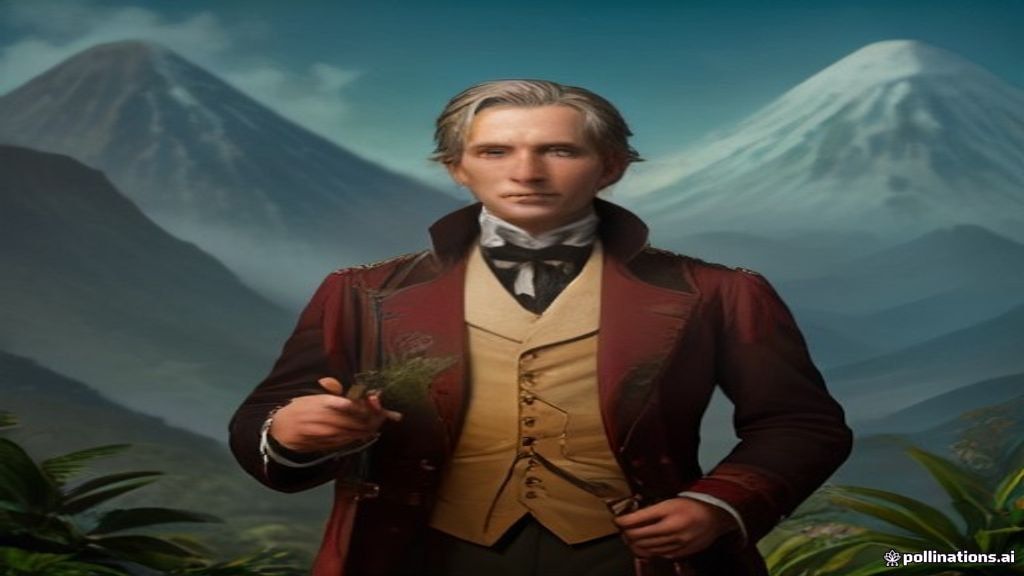
Executive Scientific Dispatch & Historical Coordinates
Lifespan: September 14, 1769 – May 6, 1859 | Major Expedition: Spanish Americas Expedition (1799–1804, with French botanist Aimé Bonpland) | Key Terrain Explored: Orinoco River, Casiquiare Canal, Chimborazo volcano, Mexican silver mines, Cuba, Washington D.C. | Scientific Breakthroughs: Coined the concept of human-induced climate change, mapped isothermal lines, pioneered biogeography and ecology, established the unity of nature (Kosmos).
In the early nineteenth century, there was no more famous man in the Western world than Alexander von Humboldt, with contemporaries remarking that his celebrity was second only to Napoleon Bonaparte. Born into Prussian aristocracy in Berlin in 1769 (the exact same year as Napoleon and the Duke of Wellington), Humboldt was a polymath of staggering intellectual breadth: a geologist, botanist, astronomer, geographer, and humanist philosopher who revolutionized how humanity understands the natural world.
Before Humboldt, Western science viewed nature through the mechanical, compartmentalized lens of Carl Linnaeus and Isaac Newton: nature was a static machine of isolated components to be dissected, classified, and filed into Latin taxonomies. During his epic five-year, six-thousand-mile expedition across the rainforests, rivers, and volcanic peaks of South and Central America, Humboldt pioneered a radically modern paradigm: nature was not a machine, but a single, living, interconnected organism—a dynamic “web of life” where climate, geology, flora, fauna, and human society constantly interacted. In doing so, Humboldt invented the modern sciences of ecology, biogeography, and environmental climatology.
The 1799–1804 Latin American Expedition: The Scientific Odyssey
Having inherited an enormous personal fortune upon the death of his mother, Humboldt resolved to finance his own scientific voyage. Through a stroke of extraordinary diplomatic fortune, in 1799 King Charles IV of Spain granted Humboldt and his companion, brilliant French botanist Aimé Bonpland, an unprecedented royal passport permitting them unrestricted access to the jealously guarded territories of the Spanish Empire in the Americas.
Landing at Cumaná in modern-day Venezuela in July 1799, Humboldt brought with him the most sophisticated battery of scientific instruments ever assembled for a private expedition: forty-two precision brass instruments manufactured in Paris and London, including sextants, quadrants, cyanometers (to measure the blueness of the sky), eudiometers (to analyze atmospheric oxygen), boiling-point thermometers, magnetometers, and Leyden jars.
Navigating the Orinoco and the Casiquiare Canal (1800)
In the spring of 1800, Humboldt and Bonpland embarked on a grueling 1,400-mile journey into the untamed interior of the Venezuelan rainforest. Squeezing into a forty-foot dugout canoe (piragua) rowed by indigenous guides, they navigated the swollen waters of the Orinoco, Apure, and Atabapo rivers, enduring suffocating humidity, virulent fevers, and swarms of blackflies and mosquitoes so thick that Humboldt had to bury his hands in river sand to write his daily observations.
Their primary geographical triumph was the empirical survey of the Casiquiare Canal—a natural hydrological phenomenon that had baffled European cartographers for generations. Humboldt proved that the Casiquiare was an authentic, living river bifurcation: a natural waterway that peeled off from the upper Orinoco River and flowed directly into the Rio Negro, linking the two colossal river systems of the Orinoco and the Amazon. By recording precise celestial latitude and longitude coordinates with his sextant, Humboldt dismantled centuries of speculative geography.
The Ascent of Mount Chimborazo: Standing on the Roof of the World (1802)
On June 23, 1802, high in the Ecuadorian Andes, Humboldt and Bonpland confronted the majestic, ice-encrusted volcanic cone of Mount Chimborazo (20,548 feet / 6,263 meters). In the early 19th century, Chimborazo was universally believed to be the highest mountain on planet Earth.
Wearing ordinary wool coats and leather boots without crampons, ropes, or oxygen masks, Humboldt and Bonpland ascended the steep, frozen slopes along a knife-edge ridge flanked by sheer drops. As the air thinned, they suffered from violent mountain sickness; their gums and eyes bled, their lips turned purple, and bitter freezing gales tore at their cloaks. Pushing through thick clouds, they were finally blocked by a massive, impassable crevasse at an altitude of 19,286 feet (5,878 meters).
Although they did not reach the ultimate peak, Humboldt and Bonpland had climbed higher than any human in recorded history—a world mountaineering altitude record that stood unbroken for three decades. Standing above the clouds, looking down upon the unfolding landscape of the Andes, Humboldt experienced a profound intellectual epiphany that crystallized his entire scientific philosophy.
The Naturgemälde: The Birth of Ecological Science
Gazing down from the slopes of Chimborazo, Humboldt realized that nature organized itself in global climatic zones. As altitude increased and temperature decreased, plant species distributed themselves in precise, predictable vertical bands that mirrored the progression from the equator to the polar ice caps: tropical palms at the base, followed by temperate oak and alder forests, sub-alpine scrub, hardy frailejones, alpine mosses, and finally perpetual snow.
Humboldt synthesized this revolutionary concept into his celebrated illustration: the Naturgemälde (“Painting of Nature”), a master diagram of Chimborazo surrounded by columns of empirical data correlating elevation with temperature, barometric pressure, atmospheric transparency, electrical conductivity, and botanical species. The Naturgemälde was the visual birth of biogeography—demonstrating that organisms cannot be understood in isolation, but only in dynamic relationship to their physical climate and geographical environment.
Pioneering Climate Science and Environmental Warnings
Humboldt was the first scientist to map global climate using isotherms and isobars—lines connecting geographic points of equal temperature and atmospheric pressure across the world map. This allowed scientists to compare climates across disparate continents independent of political borders.
Remarkably, Humboldt was also the very first thinker to warn humanity about the dangers of human-induced climate change. While studying the deforestation around Lake Valencia in Venezuela in 1800, Humboldt observed how the destruction of primary forests by Spanish indigo planters caused local riverbeds to dry up, soil to erode into dust, and local temperatures to skyrocket. He identified three primary mechanisms by which human economic exploitation altered planetary climate:
- The ruthless destruction of forests (deforestation).
- Artificial agricultural irrigation diverting natural watercourses.
- The massive emission of steam, gas, and industrial carbon in metropolitan mining centers.
Chronological Timeline of Alexander von Humboldt’s Explorations
| Date | Geographical Landmark | Scientific Milestone / Discovery |
|---|---|---|
| June 5, 1799 | A Coruña, Spain | Embarks aboard the frigate Pizarro with botanist Aimé Bonpland. |
| April – June 1800 | Casiquiare Canal, Venezuela | Surveys and confirms natural river bifurcation linking the Orinoco and Amazon. |
| June 23, 1802 | Mount Chimborazo, Ecuador | Reaches record mountaineering altitude of 19,286 feet; conceptualizes the Naturgemälde. |
| 1802 – 1803 | Pacific Coast of Peru | Measures cold, nutrient-rich oceanic current (later named the Humboldt Current). |
| May – June 1804 | Washington D.C. | Spends three weeks at the White House advising President Thomas Jefferson on Mexican geography. |
| 1829 CE | Ural Mountains & Siberia | Conducts 9,000-mile Russian expedition, establishing a global network of magnetic stations. |
| 1845 – 1862 CE | Berlin, Prussia | Publishes Kosmos, his multi-volume masterwork synthesizing all physical sciences. |
Influence on Darwin and the Masterwork Kosmos
Humboldt’s literary output was staggering. Over twenty-one years in Paris, he spent his entire remaining fortune publishing the thirty-volume Personal Narrative of Travels to the Equinoctial Regions of the New Continent. A young English Cambridge graduate named Charles Darwin read Humboldt’s narrative with obsessive passion, writing in his diary that Humboldt’s vivid prose “stirred up in me a burning zeal to add even the most humble contribution to the noble structure of Natural Science.”
When Darwin sailed aboard HMS Beagle in 1831, Humboldt’s travel volumes were his constant companions, and Darwin routinely quoted Humboldt when analyzing the Galapagos finches and South American geology. In his twilight years in Berlin, Humboldt published Kosmos (1845–1862), a breathtaking five-volume magnum opus that attempted to unify astronomy, geology, meteorology, biology, and human poetry into a single grand cosmological vision.
Key Archival Takeaways
- Holistic Ecology: Replaced static classification with the concept of the “web of life”—viewing nature as an interconnected global organism.
- Climate Pioneer: Invented isothermal mapping and was the first scientist to identify human-driven environmental degradation and climate shifts.
- Intellectual Beacon: Deeply inspired Charles Darwin, John Muir, Henry David Thoreau, and Simón Bolívar, shaping modern ecological consciousness.
Frequently Asked Questions (FAQ)
What geographical features are named after Alexander von Humboldt?
More geographical features, animals, and plants are named after Alexander von Humboldt than any other human in history. These include the cold Humboldt Current (Peru Current) off South America, the Humboldt River and mountain range in Nevada, Humboldt County in California, the Humboldt Glacier in Greenland, several towns and universities, the Humboldt penguin, and the Mare Humboldtianum on the Moon.
What was Humboldt’s relationship with Simón Bolívar?
Humboldt met the young Venezuelan revolutionary Simón Bolívar in Paris in 1804. Bolívar was profoundly moved by Humboldt’s passionate descriptions of the beauty and potential of South America. Bolívar later famously proclaimed: “Baron von Humboldt did more for the Americas than all its conquerors, for he was the true discoverer of our continent.”
Did Humboldt oppose slavery?
Yes, passionately. Throughout his writings, Humboldt was an outspoken critic of transatlantic slavery, colonial exploitation, and the subjugation of indigenous peoples. In his 1826 book Political Essay on the Island of Cuba, he explicitly condemned slavery as the greatest moral evil ever perpetrated by humanity, causing the book to be banned in parts of the American South.