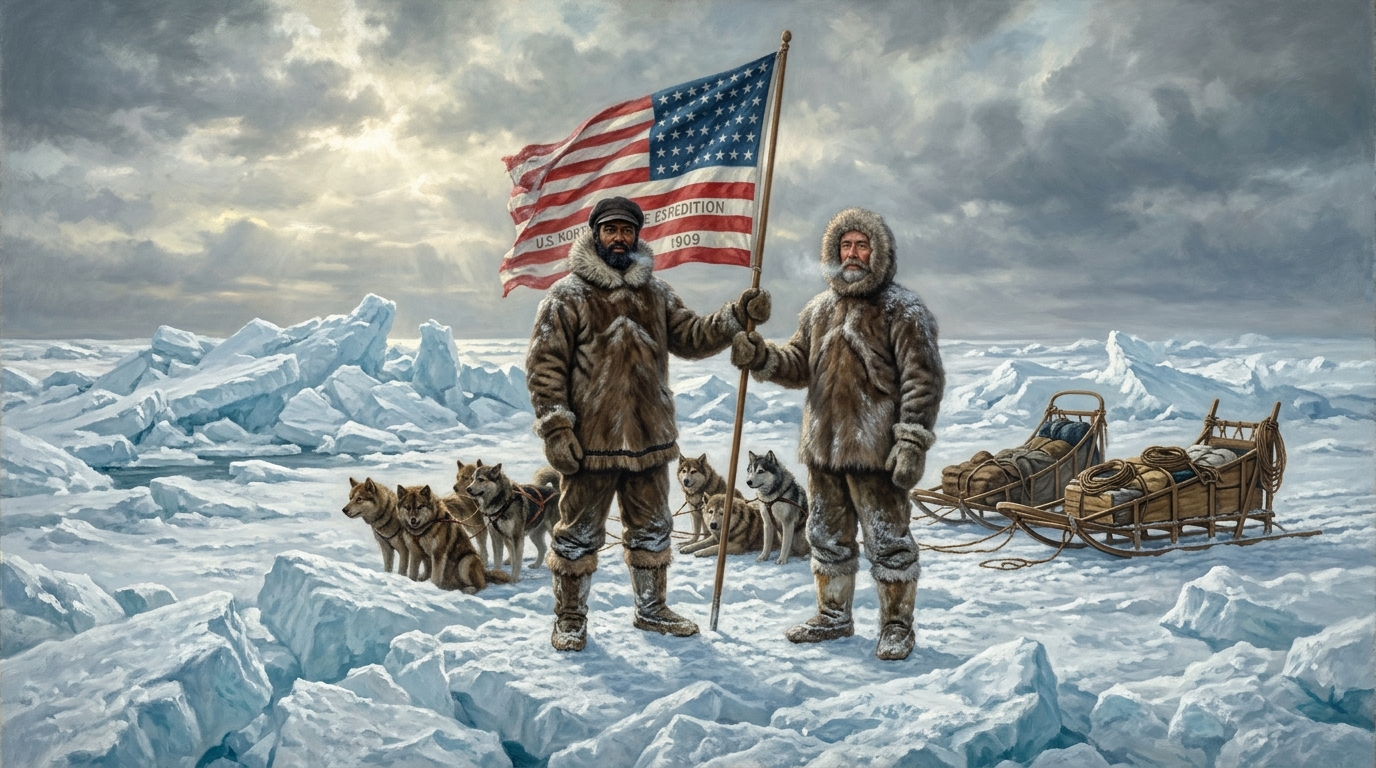
Executive Arctic Reconnaissance & Historical Parameters
Climactic Claim Date: April 6, 1909 | Base of Operations: Cape Columbia, Ellesmere Island (83°07′ N) | Primary Vessel: SS Roosevelt (custom steam icebreaker) | Pioneering Party at 90° N: Robert E. Peary, Matthew A. Henson, and four Inughuit hunters: Ootah, Seegloo, Egingwah, and Ooqueah | Core Controversy: The Cook-Peary controversy and modern navigational doubts over Peary’s recorded marching speeds.
For more than four centuries, the geographic North Pole—the frozen, shifting point at 90° North latitude where all lines of longitude converge and every direction points south—stood as the ultimate white grail of Arctic exploration. Unlike the South Pole, which sits on a solid continental landmass ten thousand feet high, the North Pole is situated over a deep, turbulent oceanic abyss (over 13,000 feet deep) capped by a shifting, constantly breaking crust of marine pack ice that drifts unpredictably with wind and currents.
The campaign to reach this desolate spot reached its zenith in the spring of 1909 through the iron determination of two men bound by a twenty-year partnership across racial and societal divides: Commander Robert Edwin Peary of the U.S. Navy Civil Engineer Corps, and Matthew Alexander Henson, an extraordinarily gifted African American explorer, master dog driver, and fluent Inuktitut speaker whose indispensable contributions were long overshadowed by early 20th-century racial prejudice.
The Peary System: Harnessing Inuit Technology
Before Robert Peary, British and American polar expeditions routinely failed because they attempted to impose military European methods on the Arctic: wearing heavy woolens, marching in formal rank, and man-hauling iron-shod sledges until scurvy and exhaustion destroyed them. Having lost eight toes to frostbite on an earlier 1899 expedition, Peary realized that survival in the high Arctic required total assimilation of indigenous Inughuit (Polar Eskimo) knowledge.
Peary formulated what became known as the “Peary System”:
- Inuit Cultural Ecology: Adopting hand-stitched clothing made from reindeer skins, sealskin boots (kamiks), and polar bear fur trousers, which allowed body moisture to evaporate without freezing into ice armor.
- Snow Igloo Bivouacs: Abandoning canvas tents in favor of building snow igloos at the end of every marching day, providing wind-tight thermal insulation heated by seal-oil lamps.
- Support Column Relay: Organizing a relay system of advance pioneer detachments that broke trail through pressure ridges, erected snow camps, and cached supplies before turning back, leaving the final assault team fresh for the dash to the Pole.
- Inuit Partnership: Recruiting entire Inughuit families from northwestern Greenland to staff the expeditions, utilizing their generational mastery of dog breeding, walrus hunting, and sledge craftsmanship.
Matthew Henson: The Indispensable Co-Discoverer
While Robert Peary served as the autocratic organizational commander, the operational heartbeat of the expedition was Matthew Henson. Born in Charles County, Maryland, in 1866 to free Black sharecropper parents just one year after the Civil War, Henson had gone to sea as a twelve-year-old cabin boy on a merchant vessel, learning celestial navigation, carpentry, and mechanics.
Hired by Peary in 1887 as an assistant on a surveying expedition to Nicaragua, Henson became Peary’s closest field associate, participating in seven Arctic expeditions over two decades. Henson achieved total fluency in the Inuktitut language, mastered the delicate art of cracking a thirty-foot walrus-hide dog whip, and could build sledges from driftwood and whalebone faster than the native hunters. The Inughuit respected Henson deeply, christening him Mahri-Pahluk (“Matthew the Kind One”), with legendary hunter Ootah stating: “Peary was the great commander, but Henson was the man who could live like us, speak like us, and drive dogs better than any white man.”
The 1909 Assault on 90° North
In September 1908, Peary’s reinforced steam icebreaker, the SS Roosevelt, forced its way through the ice of Robeson Channel to winter at Cape Sheridan on Ellesmere Island. In February 1909, twenty-four men, nineteen sledges, and 133 dogs mustered at Cape Columbia (83°07′ N), the northernmost point of land in North America, to begin the 413-nautical-mile march across the frozen Arctic Ocean.
The Menace of the “Big Lead”
The Arctic pack ice was not a smooth ice rink, but a chaotic, moving labyrinth of pressure ridges—towering walls of broken blue ice forty to fifty feet high that had to be hacked through with pickaxes. Worse still were leads: catastrophic fissures where ocean currents tore the ice pack apart, revealing wide lanes of open black seawater hundreds of yards wide.
At 84°29′ N, the expedition was halted for six agonizing days by the “Big Lead,” an immense oceanic chasm that threatened to cut them off forever. Only when temperatures dropped to -45°F did a fragile skin of rubbery young ice bridge the lead; holding their breath, the men sprinted across the flexing ice, feeling it bend like parchment beneath their snowshoes.
The Final Polar Dash
One by one, according to the master plan, the support parties turned back: Dr. John Goodsell at 84°29′ N, George Borup at 85°23′ N, Donald MacMillan, and finally Captain Robert Bartlett of the Roosevelt at 87°47′ N on April 1. Bartlett had broken trail for hundreds of miles and wept when Peary informed him that he could go no further.
For the final 133-mile assault on the Pole, Peary selected five men: Matthew Henson and four Inughuit companions: Ootah, Seegloo, Egingwah, and Ooqueah. Peary chose Henson not only because of his peerless dog-handling skills, but because, as Peary privately acknowledged, he could not bear the thought of sharing the first sighting of the Pole with any white rival officer.
Covering astonishing distances across smoother ice, on the morning of April 6, 1909, Peary took solar sextant observations indicating they had reached approximately 89°57′ N. At this point, Henson—who was scouting trail ahead of the commander—had actually overshot the Pole by several miles, making him arguably the first human to plant foot on the geographic summit of the planet. Peary produced a silk American flag hand-sewn by his wife and planted it into the snow mound, proclaiming: “I have at last tapped the Pole! Mine at last!”
The Cook-Peary Controversy
When the Roosevelt arrived at Labrador in September 1909 to telegraph the triumph to the world, Peary was greeted by an explosive sensation: five days earlier, Dr. Frederick A. Cook, a former expedition surgeon who had accompanied Peary in 1891, had emerged from the Arctic claiming that he had reached the North Pole a full year earlier, on April 21, 1908, accompanied by two Inuit hunters, Etukishook and Ahwelah.
The world fractured into fierce partisan camps: the “Pearyites” backed by the National Geographic Society, the U.S. Navy, and wealthy corporate sponsors, versus the “Cookites” backed by the European press and the general public, who viewed Cook as a romantic, humble underdog. When the University of Copenhagen examined Cook’s sparse navigational notebooks, they declared them entirely fabricated, lacking solar altitude readings and mathematical verification.
While Cook was largely discredited as a fraud (and later imprisoned for unrelated oil stock fraud), Peary’s own claims came under severe scientific scrutiny by modern navigators. Analysts such as British polar explorer Sir Wally Herbert noted that Peary’s recorded marching speeds on the final sprint—averaging over forty miles per day across moving pack ice after averaging only nine miles per day on the outbound leg—defied physical credibility. Today, most modern historians conclude that due to ice drift and steering errors, Peary and Henson likely came within thirty to sixty miles of the true Pole, an extraordinary feat nonetheless.
Chronological Timeline of the Conquest of the North Pole
| Date | Location | Historical & Operational Milestone |
|---|---|---|
| July 6, 1908 | New York Harbor | SS Roosevelt departs for northern Greenland on final polar expedition. |
| February 28, 1909 | Cape Columbia (83°07′ N) | Assault column departs northern Ellesmere Island onto the Arctic Ocean. |
| March 4 – 11, 1909 | The Big Lead (84°29′ N) | Expedition trapped by open water fissure; safely crosses on thin rubber ice. |
| April 1, 1909 | 87°47′ N | Captain Bartlett’s final support party turns back; Peary and Henson push forward. |
| April 6, 1909 | Camp Jesup (90° North) | Peary, Henson, Ootah, Seegloo, Egingwah, and Ooqueah claim the North Pole. |
| September 1, 1909 | Shetland Islands | Frederick Cook telegraphs claim that he reached North Pole in April 1908. |
| September 6, 1909 | Indian Harbour, Labrador | Peary telegraphs: “Stars and Stripes nailed to the North Pole,” igniting controversy. |
| 1988 CE | Arlington National Cemetery | Matthew Henson’s remains are reinterred with full military honors beside Peary. |
Justice for Matthew Henson: Historical Re-evaluation
Upon their return, Robert Peary was promoted to Rear Admiral by special act of Congress, showered with gold medals, and granted a lavish naval pension. Matthew Henson, conversely, returned home to a segregated America that refused to acknowledge his achievements. Forced to work as a messenger and clerk at the New York Custom House, Henson struggled in financial obscurity for decades.
Recognition came late, but decisively. In 1937, the Explorers Club admitted Henson as its first African American member. In 1944, Congress authorized a special duplicate medal of Peary’s polar decoration for Henson. Finally, on April 6, 1988, by presidential proclamation of Ronald Reagan, the remains of Matthew Henson and his wife were exhumed from Woodlawn Cemetery in the Bronx and reinterred with full military honors at Arlington National Cemetery, resting alongside Robert Peary beneath a monument celebrating the African American co-discoverer of the North Pole.
Key Archival Takeaways
- Inuit Technical Integration: The “Peary System” triumphed because it discarded rigid Victorian methods in favor of indigenous Inughuit survival arts.
- Co-Discovery Reality: Matthew Henson was the primary trail-breaker and dog-handler who physically stood at 90° North alongside indigenous hunters.
- Navigational Nuance: Modern cartographic and solar analysis suggests the expedition likely reached within thirty to sixty miles of the exact geographic coordinate.
Frequently Asked Questions (FAQ)
Who actually reached the exact North Pole first on foot?
While Peary, Henson, and the four Inughuit hunters claimed the Pole in 1909, the first undisputed, scientifically verified overland expedition to stand at precisely 90° North on foot was led by British explorer Sir Wally Herbert on April 6, 1969—exactly sixty years after Peary’s claim—completing a 3,800-mile dog-sledge crossing from Alaska to Spitsbergen.
What did Ootah say about the North Pole?
Ootah, one of the four Inughuit hunters who accompanied Peary and Henson, looked around at the shifting, barren sea ice at 90° North and famously remarked: “There is nothing here. Just ice and water.”
Did Matthew Henson write a book about the expedition?
Yes. In 1912, Henson published his personal memoir, A Negro Explorer at the North Pole, providing an intimate, human, and technically detailed account of the expedition, the Inughuit people, and his partnership with Peary.